
| At Home on the Web
©2002 by Shelley Sopher CARFAC Saskatchewan Newsletter, April 2002 |
|
|
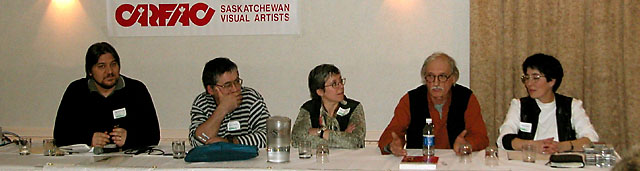 |
| Visual artists Daniel Dell'Agnese,
Charley Farrero, Susan Robertson, Victor Cicansky and Donna Kriekle were
among the 75 conference participants discussing how they use the Net for
commerce, promotion, on-line galleries and communication.
|
| When four artists talked about their Web
sites at The Internet for Artists and Craftspeople, a recent
conference in Regina sponsored by CARFAC SASK and the Saskatchewan Craft
Council, the audience was treated to a wide range of approaches and goals.
The personal Web experiences of Charley Farrero, Susan Robertson, Vic Cicansky
and Donna Kriekle included organizational, commercial, educational and
archival, as well as more purely creative sites. They built their own sites,
mainly learning by doing, or hired someone else to, while retaining control
over the content.
Although Charley Farrero was a computer programmer in France years ago before becoming a ceramic artist and settling in Meacham, until recently he hadnít even owned a personal computer, let alone produced a Web site. But he took up the challenge when, about four years, he helped Cecile Miller design a site for Sask Terra and learned about Web site design on his own with her help. It was a big leap for him -- from "clay" to "Web" -- like learning a new language. As an organizational site, saskterra.sk.ca works hand-in-hand with Sask Terraís aims to support, develop and promote works in ceramics by Saskatchewan artists. It exists for the use of both the public and members. Included are images from all Sask Terra exhibitions, profiles of members, their Sediments newsletter, upcoming exhibitions and calls for entry, and a contact list of members. Using programs like DreamWeaver and Netscape Composer (free if you have Netscape as a browser), Charley went on to design a site for the Hand Wave Gallery of which he is co-owner. He thinks of that site as a teaser, providing some images and information on gallery artists that will entice interested viewers to contact the gallery by e-mail regarding work that interests them. He says, "If someone requests a dinner set by Mel Bolen, we can take a photograph of one in the gallery using our digital camera and e-mail them a JPEG image. Weíve sold work from thirty to twenty-five hundred dollars that way." Charley advises artists to use digital images of their work in other ways as well: Send a CD with your images to galleries -- the image files can be small in order not to reproduce well and CDs are much less expensive than slides to reproduce. Charley says that in order to work on your Web site, itís not necessary to understand what HTML or meta tags mean, you just have to know how they work. But he also says that you either have to like maintaining as well as designing your Web site, or hire someone else to keep it up to date. For instance, you have to check your links once in awhile -- sometimes addresses change or Web sites fold. Susan Robertsonís teenage daughter played an important role in her Web site. While she has been working in clay for sixteen years and as a full-time, professional ceramist for the last ten, she rarely used a computer, only occasionally to type the odd letter. But she decided that if she had a Web site for her work, she could direct galleries to view images online rather than spending a lot of money getting slides shot, mailing them to galleries and not getting them back. Luckily she had a teenager at home who had been designing Web sites since she was thirteen. At the beginning Susan felt a bit intimidated: The hardest question her daughter put to her was, "What do you want your Web site to do?" When she thought more about building her Web site, she realized that it was just a form of visual communication and the process became easier. While building a Web site can be a very large project, she said it helped to break it into simple steps: "Start with your ëhome page,í a welcome page. Just doing that means youíll have to decide on a colour scheme, a list of contents, whether to include a logo." She also came to understand that she had to make her site interesting by including some personal information: "Youíre selling a piece of yourself -- youíre not just selling a piece of art." Susan uses her Web site to reflect the full range of her work, which includes both production and one-of-a-kind exhibition work. She has information for interested retailers (She currently wholesales her production work through two hundred and fifty outlets across Canada and the United States.) and she promotes her current retailers by providing a contact list by province and state. She also has images of her work and sells directly through her Web site. She sees her Web site as an inexpensive way of marketing: "What kind of advertising can you buy for one hundred and fifty dollars a year? Thatís what I pay for my domain name and Web page hosting." Vic Cicansky, an internationally-known sculptor based in Regina, says that in his lifetime heís moved from crystal sets to the Internet: When he was a boy, he built his own radio and now heís tinkering with the World Wide Web. Although, just as he has other people build his crates or mix his clay, Vic hired someone to build his Web site, he has very definite ideas on what it should look like and what it should contain. He is not interested in a marketing site, what he wants to do is attract a bigger audience. "I was interested in getting my work out there, as I wanted it to be shown, unmediated by galleries or other institutions. I wanted my text with the work in language that most people can understand." Vicís Web site creates a personal link between the artist and his audience. He has included photographs of his garden since gardening is important to him. Itís been something heís been involved in for three decades and it continually inspires his work. All of this still goes back to the work itself though. Among the photographs of flowers is "The Garden Gate," a functional sculpture in a small edition. An unobtrusive hot link connects the viewer to a gallery for purchase information. A personal tie is also created because the site is peppered with interesting text. Vic enjoys writing about what pieces he is working on, what they mean to him, how he approaches the work, and where his inspiration comes from. A recent addition to Vicís Web site is his public art, particularly images from "The Old Working Class," Sturdy-Stone Building, Saskatoon, 1978. Because this work is site-specific, its audience has been limited to viewers who visit Saskatoon -- until now. Having the work on his Web site means that anyone can view the pieces at any time. Vic also intends to begin an "archives" section on his Web site to show images of older work which, because it is in private collections, is not widely known. Another future addition to his site will be educational pages since, having taught art for many years, he has strong ideas about art education. Visual/video/digital media artist, Donna Kriekle, has a different approach: She sees the Web as a place to play, "I want to create artful Web sites. I donít know whether I want to promote myself." Over the past several years Donna has educated, or more accurately immersed, herself in digital media, with help from SOIL at Neutral Ground and the interactive media lab at the Banff Centre. She believes that artists have to take up the challenge to use the web as an artform. The webís capacity to reflect multi-layered thinking, spiral thinking, and a purely visual world is not exploited by web designers who often work to a formula and approach sites as a more linear, book-like form. One site Donna likes is creerunner.com because, "Itís a space that isnít static, and that can involve the viewer." The movement is created with simple Flash software. Another dynamic site she likes is do-not-ZZZ.com, a site about Zen in which the form is the content -- everything is Zen. She believes that everything about your site should be like that, that it should reflect your own sensibility. Whether or not you design your own Web site, you have to become familiar with the new technologies. Donna maintains that it is very easy to design your own site, but that if you do work with a web designer, do not settle for a standard template. "Describe what you want your site to be. Fill it with vision." |
|
At Home on the Web by Shelley Sopher originally appeared in the April 2002 edition of CARFAC Saskatchewan Newsletter (Vol.14 No.3) and is reprinted with permission of the author and the newsletter editor. The article is copyright © by the author and reproduction is forbidden without written permission. The sites of the four artists in the article are: Charley Farrero, www.saskterra.sk.ca and www3.sk.sympatico.ca/handwave; Susan Robertson, www.srobertsonpottery.com; Vic Cicansky, www.cicansky.ca; and Donna Kriekle, www.accesscomm.ca/users/eyeq/index.html. |